From a US$200 billion loss in market value to an S&P 100 exit, Nike’s strategy has delivered a few uncomfortable punchlines.
S&P Dow Jones Indices confirmed on 4 September 2026 that Nike will be removed from the S&P 100, not to be confused with the S&P 500, before trading opens on 21 September.
Nike joined the index in December 2008. Almost 18 years later, it is losing its seat.
But Nike will not be leaving alone. Honeywell Aerospace, Simon Property Group and Colgate-Palmolive are also heading out. Taking their places are 4 information technology companies: Dell Technologies, Palo Alto Networks, Arista Networks and Sandisk.
The quarterly rebalance is intended to keep the S&P 100 representative of its market-capitalisation range.
| Leaving the S&P 100 | Entering the S&P 100 |
|---|---|
| Nike (NKE) | Dell Technologies (DELL) |
| Honeywell Aerospace (HONA) | Palo Alto Networks (PANW) |
| Simon Property Group (SPG) | Arista Networks (ANET) |
| Colgate-Palmolive (CL) | Sandisk (SNDK) |
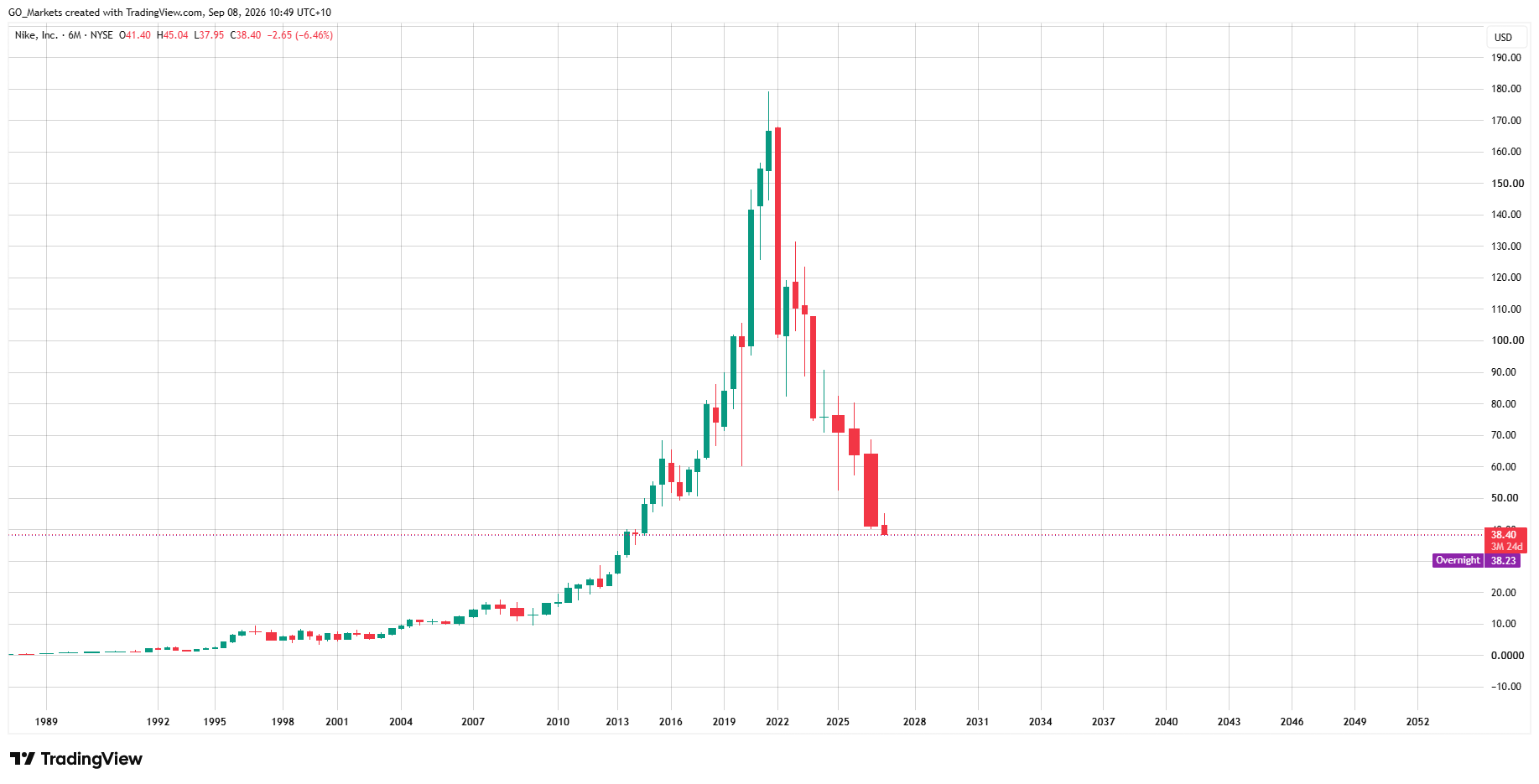
And then there is the number sitting underneath all of this. Nike reached an intraday record of US$179.10 on 5 November 2021. It closed at US$38.40 on 4 September 2026. That is a decline of approximately 78.6%.
How Nike lost its footing
Nike has faced boycott calls and wider brand controversy alongside years of strategic resets, revenue pressure and margin pressure. The financial impact of individual controversies is difficult to isolate. The numbers are easier to measure. And they tell a fairly uncomfortable story.
Source: Adobe Stock
Direct went too far
Under former CEO John Donahoe, Nike spent the pandemic years pushing hard into direct-to-consumer (DTC) sales through Nike Direct and Nike Digital while reducing its reliance on wholesale relationships with retailers such as Foot Locker, Dick’s Sporting Goods and JD Sports.

Executive Pivot: Under former CEO John Donahoe, Nike prioritised direct-to-consumer digital channels over traditional wholesale distribution, creating an opening for agile competitors in physical retail stores.
Then people went back to stores. The shelf space Nike had reduced was suddenly more contested, and smaller brands had already started moving in.
By fiscal 2026, Nike Direct revenue had fallen 6% to US$17.7 billion, including a 12% decline in Nike Brand Digital. Wholesale revenue, meanwhile, rose 6% to US$27.5 billion. Nike had spent years moving away from wholesale. Now it was rebuilding those relationships.
Retro ran out of runway
Franchise fatigue can be brutal. After years of re-releasing the Air Force 1, Dunk and Air Jordan 1 across seemingly endless colourways, Nike faced the risk that familiarity was turning into saturation.
At the same time, competition intensified in technical running, the category at the heart of Nike’s heritage. On, Deckers’ Hoka, Brooks and Saucony expanded their presence with a stronger focus on performance-led product launches. The old hits were still playing. The problem was that more competitors had joined the stage.
Greater China kept shrinking
Greater China revenue fell to US$5.85 billion in fiscal 2026 from US$6.59 billion a year earlier. That was an 11% reported decline and a 13% decline on a currency-neutral basis.
Local brands including Anta Sports and Li-Ning have gained ground alongside domestic shifts in consumer preferences. Nike also reported pressure from weaker store traffic, heavier discounting and elevated marketplace inventory in the region. That combination matters because discounting can move product, but it can also make the margin story considerably less attractive.
Tariffs and a margin story with a twist
Nike sources much of its footwear from Southeast Asia, leaving its supply chain exposed to changes in tariffs and import costs. Nike’s full-year fiscal 2026 gross margin actually edged up 20 basis points (bps) to 42.9%.
Sounds fine until you look underneath it.
Fourth-quarter gross margin jumped to 49.2%, helped by an approximately 900 bps benefit from the expected recovery of tariffs imposed under the International Emergency Economic Powers Act. Earlier quarters told a less flattering story. Gross margin fell 320 bps in the first quarter and 130 bps in the third quarter.
So yes, the full-year number went up but this is what the last 6 months looked like.
Source: Trading View
Why Adidas got there first
Adidas faced its own crisis in 2022 and 2023 after ending its Yeezy partnership. The difference is that Adidas was forced into its reset earlier. Three moves helped distinguish its path from Nike’s.
Deal with Yeezy early
CEO Bjørn Gulden arrived in January 2023 with the Yeezy problem already sitting on the table. Rather than writing off the entire remaining inventory, Adidas sold portions during 2023, generating roughly €750 million in revenue, while remaining inventory fell to about €250 million by year-end. Adidas also committed to donating part of the proceeds to charitable organisations. It was messy, but the clean-up started early.
Put wholesale back in the room
Where Nike had deliberately pulled back from wholesale accounts, Gulden moved Adidas away from a narrow DTC focus and towards stronger retail partnerships. That distinction matters. Nike later found itself rebuilding relationships it had reduced, while Adidas was telling retailers it wanted them back in the strategy.
Give people something they wanted
Then came the terrace shoe revival. Demand for Samba, Gazelle and Spezial helped restore momentum to Adidas’ lifestyle business. Its Adizero products also strengthened its presence in performance running, where Nike was facing increasingly aggressive competition.
Adidas closed at €149.15 on 4 September 2026. Its share-price path has not been without volatility, but it increasingly looks different from Nike’s prolonged decline.
And that brings us back to the index. The departing S&P 100 names span consumer discretionary, industrials, real estate and consumer staples. Every company replacing them is from information technology. That is not just a Nike story.
What the rebalance could mean for trading
Funds and exchange-traded funds (ETFs) that strictly track the S&P 100 generally need to adjust their holdings around index changes, including removing departing constituents and adding incoming ones. Nike is staying in the broader S&P 500, so this is not a market-wide forced exit from the stock.
It may, however, concentrate trading activity around the 21 September rebalance and contribute to short-term market volatility.
The divergence between Nike and faster-growing challengers can also be expressed through dispersion or pairs trades, where traders take opposing exposures across companies within the same broad theme. That describes a trading approach, not a suggestion to replicate it. Dispersion and pairs trades carry their own risks, including correlation breakdown, timing risk and unexpected company-specific events.
The turnaround is the real story now
The index change makes for the headline. The more durable question is whether Nike’s turnaround works.
Source: Adobe Stock
CEO Elliott Hill, who returned to Nike in 2024, is being judged on whether North American wholesale orders stabilise, whether Greater China finds a floor and whether Nike’s running launches can regain momentum against Hoka, On and other competitors. None of those outcomes is guaranteed.
But the scoreboard has become difficult to ignore.
Eighteen years in the club is a long time. Going from US$179.10 to US$38.40 took less than 5.

Disclaimer: Articles are from GO Markets analysts and contributors and are based on their independent analysis or personal experiences. Views, opinions or trading styles expressed are their own, and should not be taken as either representative of or shared by GO Markets. Advice, if any, is of a ‘general’ nature and not based on your personal objectives, financial situation or needs. Consider how appropriate the advice, if any, is to your objectives, financial situation and needs, before acting on the advice.