The information provided is of general nature only and does not take into account your personal objectives, financial situations or needs. Before acting on any information provided, you should consider whether the information is suitable for you and your personal circumstances and if necessary, seek appropriate professional advice. All opinions, conclusions, forecasts or recommendations are reasonably held at the time of compilation but are subject to change without notice. Past performance is not an indication of future performance. Go Markets Pty Ltd, ABN 85 081 864 039, AFSL 254963 is a CFD issuer, and trading carries significant risks and is not suitable for everyone. You do not own or have any interest in the rights to the underlying assets. You should consider the appropriateness by reviewing our TMD, FSG, PDS and other CFD legal documents to ensure you understand the risks before you invest in CFDs. These documents are available here.
Any references to Australian or international shares, sectors, indices, ETFs, crypto-related stocks or other instruments are provided for market commentary and watchlist purposes only and do not constitute a recommendation, offer or solicitation to buy, sell or hold any financial product or adopt any investment strategy. International markets may involve additional risks, including currency fluctuations, regulatory differences, market structure differences, reduced liquidity and higher volatility. Company-specific, sector-specific and macroeconomic risks may also affect performance.
Commentary on geopolitical developments, economic data, central bank decisions, earnings, policy changes and other global or financial market events is based on information available at the time of publication and may change without notice. Such events can lead to sudden market moves, price gaps, reduced liquidity, wider spreads and increased volatility, particularly in leveraged products such as CFDs. Forward-looking statements, expectations and scenario analysis are inherently uncertain and should not be relied on as guarantees of future market behaviour or outcomes.
纽元/美元价格分析:在H4图上难以突破0.5650附近的100-SMA阻力位

- 在美元走弱之际,纽元/美元吸引了一些后续买盘,但缺乏看涨信心。
- 纽储行上周的鸽派按兵不动限制了纽元走势,交易员正密切等待周五公布的美国非农就业报告。
- 技术面信号喜忧参半,在为进一步上涨建仓前仍需保持谨慎。
周四,纽元/美元连续第二个交易日获得积极牵引力,延续前一日自 0.5575 区域(或三周低点)反弹的走势。受整体走弱的美元(USD)拖累,现货价格在欧洲时段早盘升至一周多高点附近,约 0.5655-0.5660 区域。
事实上,追踪美元兑一篮子货币表现的美元指数(DXY)在选举后余波中跌至 9 月下旬以来的新低。美国中期选举中民主党横扫引发了市场对财政僵局的担忧,这可能限制政府支出并导致经济增长放缓。此外,市场对伊朗战争结束的希望打压原油价格,缓解了通胀担忧,并对美国债券收益率构成压力。这进一步削弱了美元,并为纽元/美元提供了一些支撑。
与此同时,纽元(NZD)可能难以在纽储行(RBN)上周出人意料地维持官方现金利率(OCR)在 2.75% 不变的鸽派决定后吸引强劲的后续买盘。交易员也可能不愿进行激进的方向性押注,而是选择等待周五公布的关键美国月度就业数据。广为人知的美国非农就业报告(NFP)将在推动美元需求以及影响纽元/美元方面发挥关键作用。
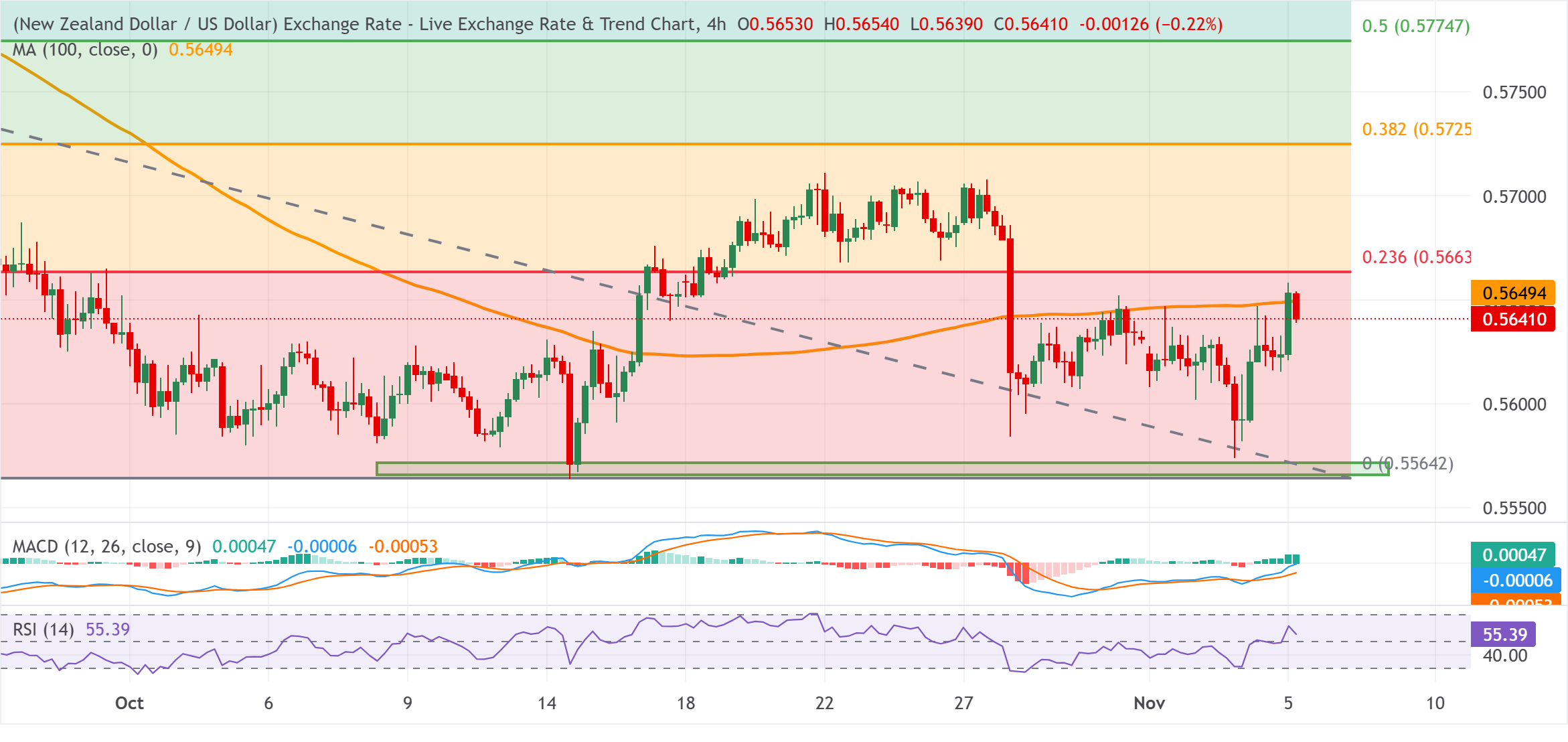
从技术面来看,现货价格在纽储行决议后的跌破以及随后在 4 小时图上 100 周期简单移动均线(SMA)附近受阻后,仍维持短期负面偏向。与此同时,相对强弱指数(14)已从近期超买区域回落至约 55,暗示看涨动能正在减弱。话虽如此,移动平均收敛背离(MACD)柱状图仍略微为正但趋于平缓,表明上行压力正在减弱,而非形成强劲趋势。
因此,在为近期自 8 月月度高点形成的、已较为明确的下行轨迹延续建仓之前,谨慎做法是等待汇价持续跌破并确认于 0.5580-0.5570 水平支撑下方。上行方面,直接阻力位于 0.5649 附近的 100 周期 SMA,其后是 23.6% 斐波那契回撤位 0.5664。只有持续突破这些阻力,才可能挑战更高的斐波那契阻力位 0.5725(38.2%)和 0.5775(50%)。
(本报道的技术分析由 AI 工具协助撰写。 了解更多。)
纽元/美元 4 小时图
新西兰央行常见问题(FAQ)
新西兰储备银行(RBNZ)是该国的中央银行。它的经济目标是实现和维持价格稳定——当通货膨胀(以消费者价格指数(CPI)衡量)在1%到3%之间的范围内时实现——并支持最大限度的可持续就业。
新西兰储备银行(RBNZ)货币政策委员会(MPC)根据其目标决定适当的官方现金利率(OCR)水平。当通胀高于目标时,央行将试图通过提高关键的OCR来抑制通胀,提高家庭和企业的贷款成本,从而为经济降温。较高的利率对新西兰元(NZD)来说通常是有利的,因为它们会导致更高的收益率,使新西兰对投资者更具吸引力。相反,低利率往往会削弱纽元。
就业对新西兰储备银行(RBNZ)来说很重要,因为紧张的劳动力市场可能会加剧通货膨胀。新西兰央行的“最大可持续就业”目标被定义为劳动力资源的最高利用率,可以随着时间的推移而持续,而不会导致通货膨胀加速。“当就业处于最大可持续水平时,将会出现低而稳定的通胀。然而,如果就业率长时间高于最高可持续水平,最终将导致物价越来越快地上涨,从而要求货币政策委员会提高利率,以控制通胀。”
在极端情况下,新西兰储备银行(RBNZ)可以制定一种称为量化宽松的货币政策工具。量化宽松是指新西兰央行印制本国货币,然后用这些货币从银行和其他金融机构购买资产(通常是政府债券或公司债券)的过程,目的是增加国内货币供应,刺激经济活动。量化宽松通常会导致新西兰元(NZD)走弱。当仅仅降低利率不太可能实现央行的目标时,量化宽松是最后的手段。新西兰储备银行在Covid-19大流行期间使用了它。
Related Articles