The information provided is of general nature only and does not take into account your personal objectives, financial situations or needs. Before acting on any information provided, you should consider whether the information is suitable for you and your personal circumstances and if necessary, seek appropriate professional advice. All opinions, conclusions, forecasts or recommendations are reasonably held at the time of compilation but are subject to change without notice. Past performance is not an indication of future performance. Go Markets Pty Ltd, ABN 85 081 864 039, AFSL 254963 is a CFD issuer, and trading carries significant risks and is not suitable for everyone. You do not own or have any interest in the rights to the underlying assets. You should consider the appropriateness by reviewing our TMD, FSG, PDS and other CFD legal documents to ensure you understand the risks before you invest in CFDs. These documents are available here.
Any references to Australian or international shares, sectors, indices, ETFs, crypto-related stocks or other instruments are provided for market commentary and watchlist purposes only and do not constitute a recommendation, offer or solicitation to buy, sell or hold any financial product or adopt any investment strategy. International markets may involve additional risks, including currency fluctuations, regulatory differences, market structure differences, reduced liquidity and higher volatility. Company-specific, sector-specific and macroeconomic risks may also affect performance.
Commentary on geopolitical developments, economic data, central bank decisions, earnings, policy changes and other global or financial market events is based on information available at the time of publication and may change without notice. Such events can lead to sudden market moves, price gaps, reduced liquidity, wider spreads and increased volatility, particularly in leveraged products such as CFDs. Forward-looking statements, expectations and scenario analysis are inherently uncertain and should not be relied on as guarantees of future market behaviour or outcomes.
NZD/USD Price Analysis: Struggles to make it through 100-SMA hurdle near 0.5650 on H4

- NZD/USD attracts some follow-through buying amid a weaker USD, though it lacks bullish conviction.
- The RBNZ’s dovish pause last week caps the NZD as traders keenly await the US NFP report on Friday.
- The mixed technical setup further warrants some caution before positioning for any further upside.
The NZD/USD pair gains positive traction for the second straight day on Thursday, building on the previous day's recovery from the 0.5575 area, or a three-week low. The momentum lifts spot prices to an over one-week high, around the 0.5655-0.5660 zone, during the early European session and is sponsored by a broadly weaker US Dollar (USD).
In fact, the USD Index (DXY), which tracks the Greenback against a basket of currencies, sinks to a fresh low since late September amid the post-election fallout. A Democratic sweep in the US midterm elections raised worries about a fiscal gridlock, which could limit government spending and lead to slower economic growth. Furthermore, hopes for an end to the Iran war weigh on crude oil prices, easing inflation fears and exerting pressure on US bond yields. This further undermines the buck and offers some support to the NZD/USD pair.
Meanwhile, the New Zealand Dollar (NZD) might struggle to attract strong follow-through buying on the back of the Reserve Bank of New Zealand's (RBN) major dovish surprise to hold the Official Cash Rate (OCR) steady at 2.75% last week. Traders might also refrain from placing aggressive directional bets and opt to wait for the release of the crucial US monthly employment details on Friday. The popularly known US Nonfarm Payrolls (NFP) report will play a key role in driving USD demand and influence the NZD/USD pair.
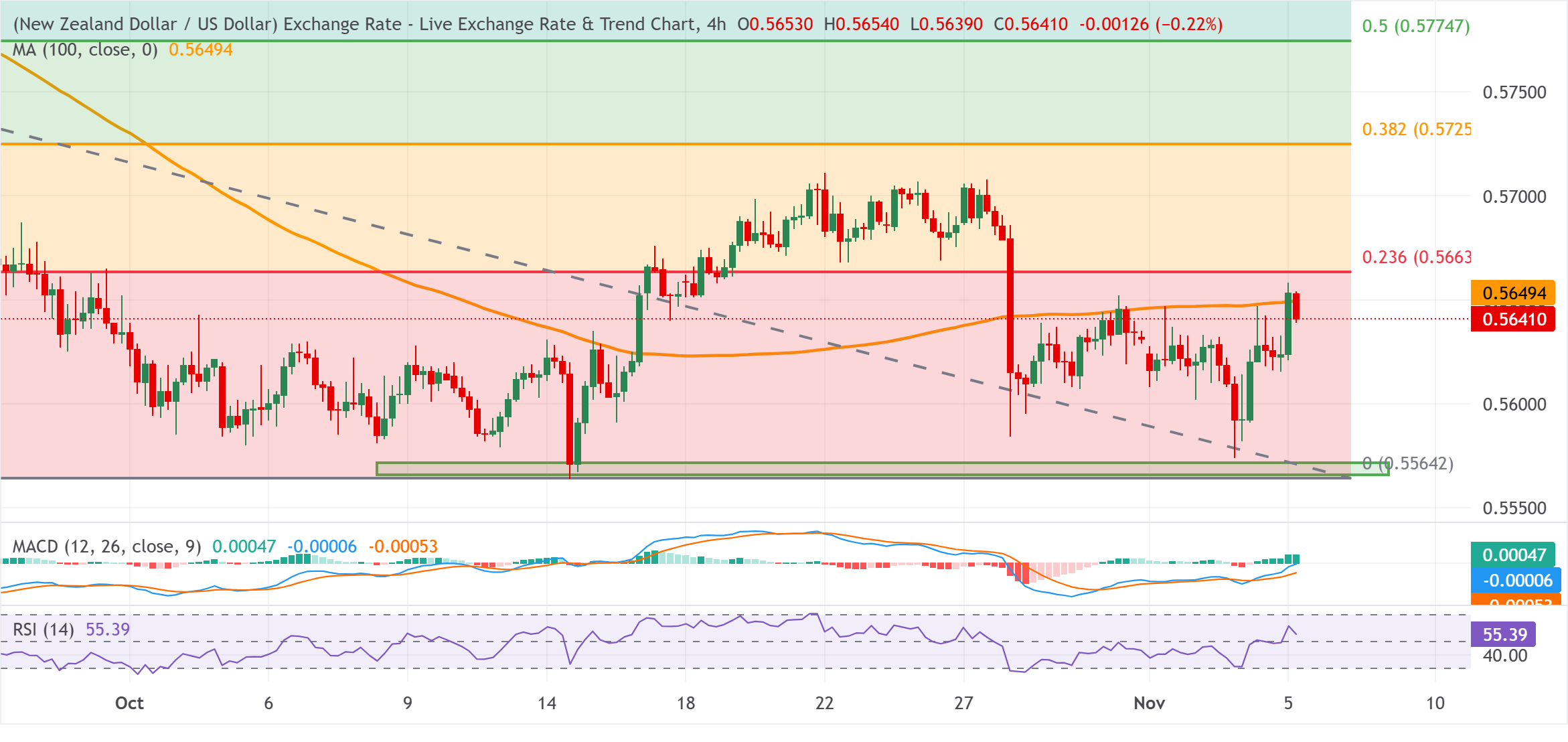
From a technical perspective, spot prices retain a short-term negative bias following the post-RBNZ breakdown and subsequent failure near the 100-period Simple Moving Average (SMA) on the 4-hour chart. Meanwhile, the Relative Strength Index (14) has eased back to about 55 from recent overbought territory, hinting that bullish momentum is moderating. That said, the Moving Average Convergence Divergence (MACD) histogram holds marginally positive but flat, suggesting fading upside pressure rather than a robust trend.
Hence, it will be prudent to wait for a sustained break and acceptance below the 0.5580-0.5570 horizontal support before positioning for an extension of the recent well-established downward trajectory from the August monthly swing high. On the topside, immediate resistance is located at the 100-period SMA around 0.5649, followed by the 23.6% Fibonacci retracement at 0.5664. A sustained break above these barriers would be needed to challenge the higher Fibonacci caps at 0.5725 (38.2%) and 0.5775 (50%).
(The technical analysis of this story was written with the help of an AI tool. Know more.)
NZD/USD 4-hour chart
RBNZ FAQs
The Reserve Bank of New Zealand (RBNZ) is the country’s central bank. Its economic objectives are achieving and maintaining price stability – achieved when inflation, measured by the Consumer Price Index (CPI), falls within the band of between 1% and 3% – and supporting maximum sustainable employment.
The Reserve Bank of New Zealand’s (RBNZ) Monetary Policy Committee (MPC) decides the appropriate level of the Official Cash Rate (OCR) according to its objectives. When inflation is above target, the bank will attempt to tame it by raising its key OCR, making it more expensive for households and businesses to borrow money and thus cooling the economy. Higher interest rates are generally positive for the New Zealand Dollar (NZD) as they lead to higher yields, making the country a more attractive place for investors. On the contrary, lower interest rates tend to weaken NZD.
Employment is important for the Reserve Bank of New Zealand (RBNZ) because a tight labor market can fuel inflation. The RBNZ’s goal of “maximum sustainable employment” is defined as the highest use of labor resources that can be sustained over time without creating an acceleration in inflation. “When employment is at its maximum sustainable level, there will be low and stable inflation. However, if employment is above the maximum sustainable level for too long, it will eventually cause prices to rise more and more quickly, requiring the MPC to raise interest rates to keep inflation under control,” the bank says.
In extreme situations, the Reserve Bank of New Zealand (RBNZ) can enact a monetary policy tool called Quantitative Easing. QE is the process by which the RBNZ prints local currency and uses it to buy assets – usually government or corporate bonds – from banks and other financial institutions with the aim to increase the domestic money supply and spur economic activity. QE usually results in a weaker New Zealand Dollar (NZD). QE is a last resort when simply lowering interest rates is unlikely to achieve the objectives of the central bank. The RBNZ used it during the Covid-19 pandemic.
Related Articles